Tuesday, June 30, 2009

i saw a film today, oh boy, the english army had just won the war

"Can I rub your ball, sir? It gives me great pleasure." Hmm... alrighty then, John. During the fall of 1966 before the Beatles started the Sgt. Pepper recording sessions, John Lennon flew to Spain to take part in director Richard Lester's newest film, How I Won the War. Lester, who had directed the Beatles in A Hard Day's Night and Help!, recruited John for this anti-war satire aimed at criticizing Vietnam and war itself. Lennon was cast as the kleptomaniac fascist Private Gripweed, a soldier under command of the clueless Lieutenant Goodbody (Michael Crawford, also a frequent collaborator of Lester in The Knack...and How to Get it, and A Funny Thing Happened on the Way to the Forum) during WWII. The task for the inexperienced troop is simple -- build a cricket pitch behind enemy lines in North Africa for the future troops arriving there. Its Lester's take on the film that is a little less so. In Lester's world, after one of the characters is killed, they never really die -- they still talk and most all of them still follow the other soldiers on their mission, the only difference is that they become a different color (pink, green, orange, blue...), which admittedly makes certain characters' deaths easier to take. There are other oddities in the film -- a cricket game with Hitler (where John's 'can I rub your ball' line comes in -- he's talking about a cricket ball, you dirty people!), a soldier who tries the entire film to seem mad and is finally dubbed insane after quoting Churchill, and tons of Lester's trademark absurd Monty Python-esque humor.
For any Lester film that I have seen -- and even most anti-war films that I've seen -- this film is comparably darker, angrier, and more critical than the others. In this film, Lester stresses the point that no good can come from war as it destroys everyone and everything involved. While Goodbody's troop seems to try to kill him off the entire film, Goodbody inadvertently causes most his troop to gradually die off. Lester's criticism of war is biting and very haunting. After Gripweed dies, he looks directly into the camera and says eerily prophetically, "I knew this would happen. You knew it would happen, didn't you?" After I saw that scene, I cried for like an hour.
Even still, this point in Lennon's life is where I crush on him the most. He cut his hair in the Army-regulated cut and started wearing his soon-to-be-trademark granny glasses for the first time. And really who can resist seeing Lennon in army fatigues and a wife beater? I love seeing photos from the set because even though the film is darkly depressing, everyone seemed to be so happy behind the scenes.

Sunday, June 28, 2009

i’m drifting in and out of dreamless sleep, throwing all my memories in a ditch so deep

Edge of Love has to be one of my favorite films that I've never seen. Starring two of the most fashionable girls around today (Keira Knightley and Sienna Miller), I fell in love with the film's English countryside wardrobe -- all those worn cardigans, rubber boots, and washed out florals looked so dreamy and wonderful to me. Unfortunately, I really didn't know anything about the film itself for a long time, except that Lindsay Lohan was supposed to do Sienna's part but then she crashed her car and got arrested, so she was otherwise busy.
The film is set in World War II (hence the retro hairstyles) and centers around Vera Phillips (Keira), who one day meets her former love Welsh poet Dylan Thomas, and finds that there are still feelings there between them, despite the fact that he is married to Caitlin MacNamara (Sienna), a free-spirited dancer. At first, there is a rivalry between the two women, but soon they grow to be good friends and together with Dylan, they live happily. When Vera marries William Killick, a soldier about to be deployed abroad, Dylan becomes openly jealous of the new addition to the group, something that Caitlin takes notice of. After William is deployed, the trio moves to the Welsh countryside where Vera's feelings for Dylan grow. After Willian returns home with war trauma, teetering on the edge of a nervous breakdown, to find his wife in an uncomfortably close relationship with Dylan, it is safe to say that he was less than pleased. What happened next was a night infamous in the literary world.
Reviews for the film were mixed -- some said that it was brilliant, others criticized the movie's less-than-accurate depiction of the events. In all honesty, I don't really care if the film is enlightening or terrible-- at least they look cute in it.

Saturday, June 27, 2009

incense and peppermints, meaningless nouns, turn on, turn in, turn your eyes around

Starting last year, my school made us have those pesky meetings with guidance counselors to discuss our goals, dreams, and futures. Well, I generally lack any realistic ambitions -- being the gypsy princess of Monaco and wife to Paul McCartney doesn't seem like the safest set path for my future -- but that didn't really phase me when I was going in to meet with them. To be honest, I had no real goals, dreams, or tentative futures that didn't involve being transported back a few decades in a time machine. I was fairly certain I didn't want to go to college, but that was never an option, especially for the mildly crazy like I. You see, I don't think about things in terms of how plausible it is or what will be best for me in reality -- to quote Blanche DuBois, "I don't want realism, I want magic!" Well, they were all well and horrified enough after just a few questions, but then the pièce de résistance when they asked me who were figures in history that I most admired. I answered truthfully -- that my personal heroes changed from time to time, but at the moment they were: Abraham Lincoln, Ice-T, and Keith Richards.
I wasn't trying to be cool or anything, because I pretty much fail at being cool/hip/with it all of the time. I was just saying the people that I truthfully thought were admirable in their careers. Well, I got lucky for starting with Abe Lincoln -- apparently he was a pretty common answer, so they didn't make me explain too much why I admired him. I said that I had a historical crush on him, not just because of his politics and rhetoric (yes, rhetoric can be sexy) but also because I thought he was handsome. Probably not the best thing to reveal that you're crushing on a man that died 1.25 centuries before you were born, but I sometimes (always) say really dumb things. Ice-T was harder to explain -- its difficult to discuss the merits of gangsta rap with a bunch of counselors. It's like trying to explain to Rush Limbaugh why abortion was a really awesome idea, I would get nowhere except possibly smacked in the mouth. But then I told them that he was the guy on Law and Order SVU, which they accepted as a suitable reason.
Keith Richards was even harder to explain to them -- the counselor even asked, "now how on earth could admire this man?" I suppose that they had this image of me, the failed product of the parochial school system, in my plaid uniform and saddle shoes laying down to worship at the feet of the dark lord of rock and roll to offer myself as his sacrificial virgin. He would be sitting on gold throne in a cloud of cigarette smoke and drenched in Jack Daniels, and decide that I was fit to be his consort. Immediately, he would shoot me up with heroin and cocaine, and I would start having lots of sex. Actually, that doesn't sound too bad a fate for me. But anyway.... I told them that Keith has been at the top of his profession for skill and originality for years, very much admired not only for his music, but also because he fought against his demons, winning the battle with drug addiction. And then I asked why they didn't like him -- was it because they didn't like his music, or because they were holding his prior problems (i.e. possibly snorting his dad, et al) against him. And then I said that a certain higher power wouldn't like that, because can't a man redeem himself? Isn't that what's it all about in the end?
I think Keith is fantastic. He probably has the best wardrobe of any rock star. With a penchant for skull rings, scarves, black leather pants, scruffed up boots, leopard print, and really great tee shirts -- he's like a pirate-cowboy-rocker-gypsy God. And I would gladly lay myself down at the feet of his throne, if he'll have me.

Thursday, June 25, 2009

weddings, parties, anything

Marilyn Monroe, circa 1957

Grace Kelly in 1955 at a Hollywood dinner

Sylvie Vartan, greeting the Beatles in Paris, 1964

Rock Hudson and his new bride Phyllis Gates,
following their wedding in 1955

Mia Farrow dancing up a storm with Ringo Starr
at the Dorchester in 1968

Julie Christie, Ursula Andress, and Catherine Deneuve
before formally meeting Princess Margaret

James Dean and Ursula Andress on a date in Hollywood, 1955

Serge Gainsbourg and Jane Birkin at the Cannes Festival

Twiggy at Disneyland in 1967

Mia Farrow, Roman Polanski, and Sharon Tate
at the premiere of "Rosemary's Baby"

Grace Kelly on a publicity date in the 1950s

Jean Shrimpton and Terence Stamp out on the town in
New York in 1964

Brigitte Bardot meeting Paul Newman in the 1960s

Marilyn Monroe at a Hollywood function in 1961

The Rolling Stones in London, 1967

work it out, shake it little mama, let me see you do the jane fonda

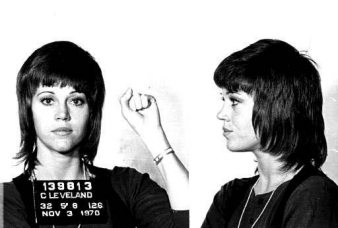
I've always liked Jane Fonda a lot, but kind of in the way one might like pitbulls or the movie "300" -- the idea of her is a bit intimidating to me, but its comforting to know that she's out there doing her thing, as long as nothing is directed toward me. She's not an intimidating-looking person really in any respect (well when she had her Hanoi Jane haircut, arguably she was...) --she's quite petite and really very beautiful, so I guess its more in the way she speaks and carries herself that gets me. Everytime she enters the screen in a movie, I watch her because its like she's forcing everyone to look at her. I could never imagine Jane playing a character that was delicate or a pushover, just because Jane could never be that person. Jane is best when she's playing an ass-kicking TV reporter, or an ass-kicking prostitute, or an ass-kicking office worker, or an ass-kicking futuristic crimefighter. Essentially whatever role where she can kick ass -- physically or metaphorically -- is where Jane will succeed most. I'm not even going to talk about this one because she takes her insane intimidation abilities to new heights. The closest Jane ever came to playing a very vulnerable, emotionally abused character was in On Golden Pond, and even then she was playing a character who used to kick ass.
I remember in a scene in California Suite where she gets complimented by Alan Alda, and she just turns to him and scoffs "Fit? You think I look fit? You awful shit, I look gorgeous!" I just remember thinking that Alan Alda's proper response should have been to sink cowardly and say "Yes, ma'am" quietly before excusing himself to go cry in the bathroom.
I've always really liked it when she costarred with Robert Redford in movies, because I think their differing personalities worked well together. I remember reading a quote where Jane said that everytime they filmed a movie together, she would fall in love with him all over again. Together they starred in "The Chase," "Barefoot in the Park," and "The Electric Horseman." Barefoot in the Park is my favorite of the films that they did together because, unlike the others, it was an unapologetically sweet romantic comedy -- Jane played a charmingly ditzy bride trying to adjust to being a wife and still be a free spirit, and Robert played her adorably square conservative husband who just can't seem to shake things up. I think this is my favorite type of character that Jane plays -- one who is a bit kooky, a bit intimidating, but very lovable indeed.

Wednesday, June 24, 2009

ooh, what to do? not a sausage to do

Okay so I'm making a resolution to start writing shorter entries, because I'm thinking that I sort of drone on and on in most my posts. I hardly think that people are interested in reading what elementary school so-and-so graduated from or seeing somebody's random list of singles they released forty years ago that nobody's ever heard of. Am I right? I'm not sure, but I just posted the entry on Bob and Sara Dylan, and I was scrolling down to make sure that none of the line breaks had gone funky, and I realized that it wasn't stopping. It annoyed me, and looking at the length of it, I didn't feel motivated to read it. But I wasn't sure if that was because I had written it so I didn't want to read it, or because I babble a lot about meaningless junk.
Also, I have come to another crossroads -- now I am secondguessing the collages that I do for each entry. I like to do them and I think they're fun, but I'm not sure if that's what other people like. I personally like both -- I'm a total nerd so a nicely done collage makes me smile with glee, but I also love scrolling to see tons of pictures of fantastic looking clothes and/or boys. I guess I have to decide pretty soon because I am getting a new computer (finally!) so I need to decide what to do with all of my photos so that they don't end up more lost than Atlantis. Wow, okay now I'm realizing that I'm babbling in my entry that criticizes how I babble. Okay, I'm shutting up now.


Speaking of being really random, here is a still from the single most fantastically random scene in cinematic history: the intermission scene from "Help!"

she might think that i've forgotten her, don't tell her it isn't so

Their marriage has been called one of rock’s greatest romances. The relationship of Sara and Bob Dylan, married from 1965 to 1977, spawned several of Dylan’s greatest songs. The duo, both incredibly weary of the public eye, has never offered a lot of comments about one another in the press, even during their twelve-year relationship, and it’s Bob’s songs about Sara that have remained the lasting testament of their relationship.
Bob and Sara allegedly met in Greenwich Village in 1962, though this is unfounded. At the time, Sara was known as Shirley Noznisky and was working as a model and bunny at the Playboy Club in New York City. While modeling, she met her first husband photographer Hans Lowndes, who she married in 1960 and by whom was convinced to change her named because he “couldn’t be married to a girl named Shirley.” She had a daughter Maria in 1961, but their marriage was quickly crumbling. In 1964, Sara attended the wedding of one of her good friends Sally to Albert Grossman, who was Bob Dylan’s manager. The wedding was most likely the first time that Sara and Bob met. The two became involved very quickly and seriously throughout 1964, Sara noting how Bob had seemed to adopt Maria as his own daughter. Together, they moved to the Chelsea Hotel, albeit in separate but near rooms, but even though they were seriously involved, Dylan continued his relationships with several women, including Joan Baez and Edie Sedgwick.
In November 1965, Bob and Sara were married in a very private ceremony – nobody was to find out about the wedding for several months, not even Dylan’s parents, until an article published February in the New York Post titled “Hush! Bob Dylan Is Wed.” Together, the newlyweds moved into a house in Woodstock New York, and welcomed a son, Jesse Byron, in January 1966. Later that year, Dylan was in a motorcycle accident that led him to withdraw extensively from the public, rarely making appearances for the next eight years. Of the crash, he said “when I had that motorcycle accident…I woke up and caught my senses… I had a family and I just wanted to see my kids.” With Dylan not touring or doing appearances, he took care of his growing family: Maria, Jesse, Anna, Sam, and Jakob; the role of dad fit him so well that friends would say that they’d never seen Bob happier than during that time.
By the mid-1970s, with Bob back to touring and apparent having affairs with Sally Kirkland, Ellen Bernstein, and reconnecting with Joan Baez, the marriage was put under undue stress and the couple became rather estranged. But still, together they filmed “Renaldo and Clara,” a movie written and directed by Dylan during the Rolling Thunder Revue tour during 1975-1976, with Bob also playing the role of Renaldo, and Sara playing Clara. That wasn’t all – Joan Baez plays the part of the Woman in White. The film had the three in a love triangle eerily similar to what was happening off-screen as Sara encouraged her husband to return to Woodstock more to be with their family, and Joan encouraging Bob to return to writing his political songs.
Apparently it was during this tour that Sara confronted Dylan about his infidelities and increasingly odd behavior. According to Baez, Sara showed up backstage one night “looking like a madwoman, carrying baskets of wrinkled clothes, her hair wild and dark rings around her eyes,” and she began to verbally attack Dylan over his drinking, cheating, and drug use. From this point on the marriage became increasingly distant, until Sara finally filed for divorce in early 1977, claiming that Bob’s bizarre behavior has made her and their five children greatly worried. She said, “I can’t go home without fear for my safety. I was in such fear of him that I locked doors in the home to protect myself from his violent outbursts and temper tantrums…He has struck me in the face injuring my jaw.” The proceeding divorce was bitter, and the following custody battle was worse. Bob and Sara remained on unfriendly terms for the next few years before reconciling their relationship in the early 1980s, even considering remarriage in 1983. Today, they are friends, with Sara occasionally attending his shows and Bob referring to Sara in “Chronicles: Volume One” as “one of the loveliest creatures in the world of women.”
The only time Bob ever spoke about his marriage openly with the press was in 1978 when he was doing a lot publicity for “Renaldo and Clara.” Still in the wake of his divorce and custody battle, Dylan reflected on his marriage, saying, “Marriage was a failure. Husband and wife was a failure, but father and mother wasn’t a failure. I wasn’t a very good husband…I don’t know what a good husband is. I was good in some ways…and not so good in other ways… There aren’t really any mistakes in life. They might seem to knock you out of proportion at the time, but if you have the courage and the ability and the confidence to go on, well, then… you can’t look at it as a failure, you just have to look at it as a blessing in a way…”
Of his marriage with Sara, Dylan would say that he “figured it would last forever… Most people…keep some contact, which is great for the kids. But in my case, I first got really married, and then got really divorced. I believe in marriage. I know I don’t believe in open marriage. Sexual freedom just leads to other kinds of freedom. I think there should be a sanction against divorce. Why should people be allowed to get married and divorced so easily?”
Sara is believed to have inspired some of Dylan’s most emotional songs, including: “Isis,” “We Better Talk This Over,” “Abandoned Love,” “Down Along the Cove,” “If You See Her, Say Hello,” “Wedding Song,” “On a Night Like This,” “Something There is About You,” “I’ll Be Your Baby Tonight,” “To Be Alone With You,” “If Not For You,” “Where Are You Tonight? (Journey Through Dark Heat),” “Love Minus Zero/No Limit.” One song that is known to be about Sara is “Sad-Eyed Lady of the Lowlands,” which was confirmed by Dylan’s other song about her, appropriately titled “Sara,” with the lyrics I can still hear the sound of the Methodist bells/ I had taken the sure and had just gotten through/ staying up for days in the Chelsea Hotel/ writing Sad-Eyed Lady of the Lowlands for you. The albums following the estrangement and breakup of the marriage – 1975’s “Blood on the Tracks” and 1976’s “Desire” – are said to be largely inspired by Sara.
Related Posts Plugin for WordPress, Blogger...