Saturday, January 31, 2009

hey babe what's in your eyes? i saw them flashing like airplane lights

Possessing something Marianne Faithfull referred to as “evil glamour,” it is easy to describe Anita Pallenberg as bewitching. The embodiment of the gypsy-esque look she is now infamous for, the Italian-born Anita has a continental style of dress and mind – reaching from Eastern, native America, European, and Asian sources to create a look unique to her. From years of alcohol, drugs, and general hard-partying, Miss Pallenberg indeed looks older than her 65 years; she has had two hip operations and walks with a limp, and also lives with hepatitis C. But I suppose this is the price one would have to pay to live a life like she has.
After being expelled from her German boarding school at sixteen, Anita spent some time in Rome, then lived in New York City and hung out with the likes of Andy Warhol, and then moved to Paris to become a model. In Munich in 1965, Anita and a friend went to a Rolling Stones concert where they managed to get backstage. This was where she first got together with Brian Jones, who she stayed with for two years. She describes their relationship as volatile, citing Jones’s paranoid and abusive nature as what led her to leave Jones for Keith Richards during a Moroccan vacation the three took in 1967.
After getting together with Keith, she ironically saw less and less of him because girls weren’t allowed in the studio or on tour while they were working. To fill the time, Pallenberg became an actress, working in films such as “Barbarella” and “Performance” (alongside Mick Jagger, who she was rumored to have an affair with during filming) and began delving into drugs such as heroin and alcoholism, a hobby she shared with close friend and Rolling Stone girlfriend Marianne Faithfull. During these years she had three children with Richards: a son Marlon in 1969, a daughter Dandelion (now Angela) in 1972, and a son Tara, born in 1976 but who passed away at only ten weeks old.
In addition to acting as a muse (at least two songs – “Angie” and “You Got the Silver” – were written about her), Anita had a considerable influence on the sound and look of the Rolling Stones. As the PA to the band in the late sixties and early 70s, Jo Bergman, said, “Anita is a Rolling Stone. She, Mick, Keith, and Brian were the Rolling Stones. Her influence has been profound. She keeps things crazy.” At her request, tracks from Beggars Banquet were remixed and her interest in occult and dark magic had a considerable influence on the Sympathy for the Devil years.
I personally admire her rich hippie style – her mix of fur coats, silk poet blouses, leather pants, bangles, bowler hats, Indian beads, gladiators all worn in an artfully haphazard way. Her kohl-rimmed eyes and messy blonde bed head has been inspirational to many; the most notable of her style protégées is Kate Moss, a friend of Miss Pallenberg’s.


Further reading:
http://rockpopfashion.com/blog/?p=33

http://nogoodforme.filmstills.org/blog/archives/2008/03/21/style_icon_anit.html

http://www.marieclaire.co.uk/fashion/best/3194/1/6/sixties-style-icons.html

The Pattie Chronicles: 1967 Style

Pattie rocking Eastern influences and psychedelic styles
x
This was where Pattie really had the most fun with her look. During this period, the Beatles and friends were very much interested in Eastern culture – something that was evident in all their wardrobes. Almost every piece in her wardrobe was a multitude of colors or at least a very beautiful, ornate pattern. Her accessories were killer during this time – she had the most beautiful sandals and the greatest stone rings.
The essentials: Flowy minidresses (chiffon, empire waist dresses), bell bottom denim, Indian vests, crocheted piano shawls in light colors, color-tinted sunglasses, large brim floppy hats, knee-high boots and gladiator sandals (in suede), tunic tops, large belts, even shorter miniskirts, tons of accessories (hippie headbands, long strings of beads worn together, shawls and scarves, piles of bracelets and stone rings on multiple fingers), Pattie also wore flowers in her hair occasionally – a very hippie thing to do
Hairstyle: Pattie switched between completely grown out hair and her blunt bangs – both of which looked great with her longer hair. She always parted her hair down the middle and it seems like during this period she lightened her hair from the dark blonde of 1966 to a very light honey color in late 1967.

Good Read - Dandelion: Memoir of a Free Spirit

Raised by a mother who makes Joan Crawford look loving and an alcoholic absentee father (later fond of gender-bending), Catherine James always dreamed of breaking free from her family’s control over her. Throughout her childhood, Catherine was abused physically and emotionally by her mother, a shamelessly destructive and self-involved woman who believed that socializing with the Los Angeles elite to be more important than raising her young child. James recounts times when her mother would tie her to a chair or lock her in a closet before she went out in order to keep her daughter out of “harm’s way,” or would feed Catherine stale rotting food doused in Tabasco sauce for dinner. The abusive relationship Catherine has with her mother becomes the pattern for every relationship to come – time and time again, she is left emotionally pummeled by the person closest to her. But even still, James’s optimism remains and she can find the silver lining in the more heartbreaking of experiences.
By twelve Catherine James was declared a ward of the state, living in an orphanage. At a performance in Santa Monica, she had a chance meeting with a 22-year-old Bob Dylan, the first person to really inspire her to break out. And break out she did. In 1964, Catherine moved to Greenwich Village to seek out her new mentor when she was only 14 years old. Soon enough she was partying with rock stars and landed herself a screen test with Andy Warhol. When she was sixteen, she became involved with Denny Laine (of the Moody Blues, Airforce, and Wings) and moved with him to London where she had a son with him, Damian James. For a while when Laine comes into the picture, we think that he is Prince Charming here to save our damsel in distress; he treats her well, takes her partying with the Beatles, the Who, and the Rolling Stones, but soon his own abusive nature is revealed and our dear Catherine is forced to endure more torment from someone she loves. She finally leaves him, moving with her son back to California and enjoying a romance with Jackson Browne, but is lured back to London by Laine, who promises he has changed and wants them to raise their son together. After a few blissful months together, their relationship once again becomes abusive and she one again leaves him. By nineteen, James is living (platonically) with Eric Clapton, cooking his meals and aiding him through his then-unrequited obsession with Pattie Boyd. She also enjoyed dalliances with Jimmy Page throughout the seventies while she lived in Connecticut with her son and became a model for Wilhelmina.
The memoir of a child living in an adult world, the story of Catherine James’s life is a compelling one. Through all the heartbreak that she lived through, “Dandelion” does not wallow in past unhappiness but shines with the author’s sweet optimism. James’s journey to find love and flee abuse is so that at times it reads like fiction. I believe Miss Pamela (authoress and memoir-extraordinaire of “I’m With the Band” and “Let’s Spend the Night Together”) said it best with, “‘Dandelion’ tells the courageous nine-lives tale of an exquisite beauty’s great escape from a turbulent childhood, free-fall into the revolutionary rock music scene, a child raising her own child amidst chaotic upheaval. Audacious and dauntless, Catherine James maintains her sweetness and vulnerability, even when facing down her demons. From the Hollywood heyday to swinging Mod London, to the streets of Greenwich Village and back again, she takes us to shadowy and brilliant places, introduces us to ghastly and illustrious characters, sprinkling heartfelt wisdom and insight on every page.”

Wednesday, January 28, 2009

with your long blonde hair and your eyes so blue

Have you ever experienced love at first sight? That is what I felt when I first saw Sienna Miller in the film "Alfie." She was the only highlight for me in an otherwise lackluster film, an ill-conceived remake of the charming 1966 version featuring Michael Caine. When I first saw her long blonde hair, kohl-rimmed eyes, and peasant-chic wardrobe, I knew I had found my new role model. She was the embodiment of a revived Sixties girl, that quintessential swinging style that I for so long admired but could never quite achieve.
In the film Sienna plays Nikki, a free-spirited wild child with a penchant for rage blackouts and a dislike of her medication. The role was in itself a reimagining of the role Jane Asher had in the '66 version where she played Annie, a teenaged runaway who symbolized Swingin' London youth. Nikki is a rather complex character, a hopeless romantic who naively believes that all she needs is love -- because she is with Alfie, she believes her bipolarity has been cured and she will be happy all the time. Though Nikki is is the briefest paramour that Alfie has in the film, she is the most resonating.
Sienna's wardrobe is possibly my favorite from any film of recent years. Her shoulder-duster earrings, fur jackets & vests, crocheted sweaters, beat-up cowboy boots, gold chains, floppy hats, Moroccan belts, mocassin knee-highs, peasant skirts and blouses are as envious now as they were then. It was her look as Nikki that singlehandedly brought back full force the hippie look in 2004/2005, inspiring countless designers and fashionistas alike to be more "boho."

Good Read - I Me Mine

Okay, this is more of Harrison’s insight on and inspiration surrounding the many songs of his career than a real memoir, but this is the closest we have to any Beatle writing an autobiography. The introduction, written by his widow Olivia, is a tender and personal look at what Harrison (and his music) meant to others. Featuring the personal copies (and the revisions) of over eighty of Harrisons songs, “I Me Mine” also includes archival photos of the great man during different periods of his life (with amusing captions to go along with them), and a brief “biography” of his life. But this book is more about Harrison’s music (and at times, religious beliefs), not him self. I think that this is just one indication of how not conceited George Harrison was – never considering the self as being important, just the things we do in life. Before his death in 1980, John Lennon openly expressed unhappiness that Harrison only mentioned his names a handful of times throughout the book. Lennon considered himself as an influence and aid to his former band mate when Harrison was establishing himself as a songwriter and lacked Lennon’s experience or wordplay skill. But Lennon apparently failed to realize that his name was mentioned more times than Ringo’s name, Paul’s, or George’s first and second wives combined. But that was just George’s nature, I suppose, though it’s a shame that his reserve and discretion over personal details caused his former collaborator to think that he undervalued their partnership. In the bits that George does write, his dry and deprecating sense of humor soaks through. For the song “Blue Jay Way,” inspired by Derek and Joan Taylor’s now-infamous tardiness, he writes: “the mood is also slightly Indian. Derek Taylor is slightly Welsh.” He is quick to dismiss songs like “Don’t Bother Me,” saying he didn’t “think it’s a particularly good song, it mightn’t even be a song at all”; calls “Beware of Darkness” as having a melody that’s “sort of strange”; finds fault that “So Sad,” written while he was splitting up with Pattie, “is depressing, it is so sad.” He even rewrote the bridge to “I Want to Tell You” to suit what he felt the song was truly communicating. Published over two decades before his death, “I Me Mine” still remains a perfect account of Harrison’s life, worthy to read if even just to hear the Quiet Beatle in his own words. And who would not be enticed by his introduction, which states, “I have suffered for this book; now it’s your turn.”

Good Read - Faithfull: An Autobiography

I am honestly fascinated/enamored/in awe of the life Marianne Faithfull has lived. Her story – marked by addictions, glamour, great successes, and even greater tragedies – resembles more of a Thomas Hardy novel than someone’s autobiography. As heartbreaking and unbelievable Faithfull’s story is, it is her story, and it is the truth; she emerges as Hardy’s romantic heroine of the Swingin’ Sixties. In comparison to the any number of memoirs written about the sixties, Faithfull’s book is far and away the most tragic of the bunch. After reading this rather emotionally-draining tale that could’ve encompassed four or five lifetimes, it’s hard to believe she was only 47 when this was published. Growing up in a strict Roman Catholic household, Faithfull was a child of divorce whose early years were marked by attacks of tuberculosis and poverty. After leaving school at seventeen, Marianne found success as a folk singer in London. Just as her singing career took off (her first single, “As Tears Go By,” released in mid-1964), she married John Dunbar in 1965 and had a son six months later. It was during this time she began hanging out with such luminaries as Bob Dylan and the Rolling Stones. At this point in the book, Marianne reveals her romantic entanglements with Dylan, Jagger, Richards, and Brian Jones. She also admits that although she was an international superstar, her artistic input over her image and her music slowly diminished; she continually rejected the innocent, angelic image the press and her music label forced on her. After recounting her reign as pop princess, Faithfull switches gears to describe her downfall – her breakup with Mick, her deeper descent in drugs, her loss of custody rights over her son, several suicide attempts, and her eventual homelessness during the Seventies and eighties. This part of the book is easily the most depressing – her many misfortunes are rarely offset by luck in Ms. Faithfull’s life (apart from her comeback of sorts in “Broken English”). A strength I found in Faithfull’s book is that she admits all her mistakes, at times taking more blame than I believed she deserved. She describes herself as a victim of cool, both indulgently describing and mocking the hedonistic nature of the 1960s, the “free love, psychedelic drugs, fashion, Zen, Nietzsche, tribal trinkets, customized Existentialism” that was so much a part of her life. The maturity Ms. Faithfull possesses is apparent when reading her reflections on her youth. She gives balanced and personal descriptions of Bob Dylan, the Beatles, Allen Ginsberg, Anita Pallenberg, and the Rolling Stones, most touchingly of Mick Jagger. She doesn’t describe their relationship in terms of sensationalism – it seems like a genuine relationship of young love, recounting the ups, the downs, the headiness, the detachment, the romance and the melancholy that comes from a true love affair. It was her ironic and dry sense of humor that saved this book from becoming the most depressing book ever written. An example of her wit was when she contemplated, “Who was the great love of [Mick Jagger’s] life? Actually, I think it was Keith.” And in the end, realizing her story was far from complete at only 47 years old, Faithfull ends her book with a set of cooking recipes and tips.

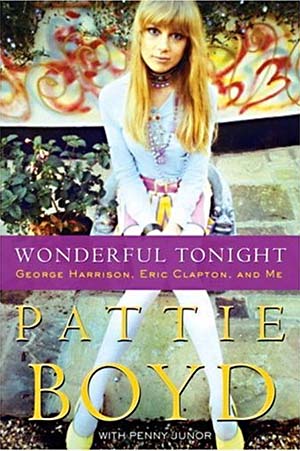
Good Read - Wonderful Tonight: George Harrison, Eric Clapton, and Me

This is one of my favorite autobiographies by anyone in the sixties --- not because of the writing (which, at times, is less than superb...example: "We were all out on the town; we were young, we were gorgeous, everything was fabulous".... not exactly Hemingway…), but because of the essence of the story. I am not shy about my love for Pattie Boyd, so when she released her autobiography in late 2007 I was incredibly excited to say the least. It was rumored that Ms. Boyd wrote her account in order to dispel/compete with things that Eric Clapton’s autobiography (also released in late 2007) would claim; both Boyd and Clapton’s accounts match up for the most part (overlooking the George & Eric guitar duel for her honor that Pattie writes about). My favorite part of the book is about her and George’s happier times. She writes about their shy courting sessions on set of “A Hard Day’s Night,” their Tahitian vacation with the Lennons, and just hanging out at their honeymooner home Kinfauns. Things start to go downhill as George becomes more and more immersed in religion and music – oftentimes leaving Pattie alone for hours, days – and selling Kinfauns in favor of the gothic mansion Friar Park without even telling Pattie beforehand. This, alongside George’s philandering and Pattie’s growing relationship with Eric Clapton, led to some of the more heartbreaking chapters of this book. When Pattie tells her husband she’s leaving him to go on tour with Eric in the US, George’s quiet and solemn cry for her to “Please don’t leave” quite literally brought tears to my eyes. The next chapters of the book are even more depressing as Pattie recounts her new beau’s spiraling addictions and how helpless she felt to save him from himself. She also describes how Eric’s many affairs – most notably the conception of his son Conor with another woman – caused her to realize that the years of adoration and devotion Eric pledged to her while she was married to George were just the thrill of the chase for Eric. Though written with the aid of a ghostwriter, Pattie’s book is still immensely personal. It is obvious she hasn’t overcome the pain her second husband put her through, and views her leaving George as ‘the greatest regret of [her] life,’ who she now sees as her soul mate. I think that everyone should read this book, if not just to get a greater understanding of one of the most infamous love triangles in history. With “Wonderful Tonight,” Pattie proves she’s still got us own our knees.
Related Posts Plugin for WordPress, Blogger...