Showing posts with label A Good Read. Show all posts

Friday, February 5, 2010

dandelion don't tell no lies, dandelion will make you wise, tell me if she laughs or cries, blow away dandelion


After being royally gypped in Almost Famous, Zooey Deschanel has finally gotten her chance to play a groupie. According to HBO, Deschanel will produce and star in an adaptation of Pamela Des Barres' epic memoir I'm With the Band. Though she's published other accounts of her life, I'm With the Band is my personal favorite and I'm glad to see this one going into production.
Miss Pamela (born Pamela Ann Miller in 1948) was a girl just like all the rest of us - she had dreams about musicians that she deemed too fantastical to come true, the only difference is that one day she decided to make them come true. A Southern California resident, Pamela spent her teenage years hanging out with groups like the Byrds, content to be friends with musicians, until she befriended Captain Beefheart, who introduced her to several of the Rolling Stones and Frank Zappa. Zappa would play an influential role in the rest of her life - she would become the live-in nanny to his kids and he would be the creator of her group the GTOs. During her years as a groupie, Des Barres famously bedded Mick Jagger, Jimmy Page, Noel Redding, Jim Morrison, Nick St. Nicholas, Gram Parsons, Brandon de Wilde, Chris Hillman, Michael Richards, Keith Moon, and a pre-Miami Vice Don Johnson.
Pamela Des Barres had the most gorgeous late-sixties hippie child fashion sense. She was oftentimes seen wearing ankle-length Victorian style dresses or tight minidresses in loud prints. She loved to draw small stars and hearts near her eyes, and painted her eyelids like they were half-moons. With light blonde hair that fell in soft waves, she looked utterly angelic frolicking around California with hippies and musicians. My favorite quote about her style comes from Miss Pamela herself in I'm With the Band:
  • "A hippie was sort of the unwashed, unkempt kid. A freak was someone who put a lot of cure and intention into their appearance, wanting to stand out instead of blend in. I was a combination flower child-freak, because the former was all about love and sharing and adoring each other and having flowers in your hair, literally, and lace and feather and all that. I never considered myself a hippie. She'd be wearing one of those Indian madras-type skirts with her hair split down the middle, no makeup, sandals, braless - of course, we were all braless. I would have on an old vintage lace tablecloth with ribbons woven through it, feather in my hair, loads of makeup, sequins stuck all over my face, and spike heels."
I found her book refreshing - as opposed to a trashy tell-all by desperate hanger-on, or an ode to your own awesomeness (cough Bebe Buell's book cough), Des Barres is candid, sweet, and honest. She talks openly about her lack of cleavage, and concentrates as much on the aftermath of a relationship as the dirty little romantic details. A breast cancer survivor, a fanatical James Dean fan, the alleged inspiration behind Penny Lane in Almost Famous, the star of the world's only 'groupie group' the GTOS, I'm glad to see Miss Pamela receive some mainstream adoration.
And, with the fantastic Miss Deschanel involved, my interest is further piqued. But my question is - at 30 years old, is Zooey too old to play the free spirited girl-child? And who is going to play the famous rock stars (Mick, Jim, and all)?

Tuesday, December 22, 2009

The Dolly Rocker Girl Dream Christmas List

1. Betsey Johnson Faux Fur Raggy Coat: its so chic, warm, and if paired with Chuck Taylor converse, green pants, and a red button down it would be very George-at-the-rooftop-concert apropos, or alternately when worn with a gypsy caftan, ethnic baubles, and a swipe of kohl eyeliner it will look right out of the closet of Anita Pallenberg.
2. Vera Wang Rose Tie Necklace: at $650 it's a very pricey piece, but I cannot get over the romantic glamour of the nude rosettes combined with the dark crystal facets and black satin ribbon. But hey, that's why this is a dream list, right? Santa I'm sure can get a little creative for little ole' me.
3. House of Harlow 1960 Gold Aztec Bangles: for an instant luxe-hippie look, I would stack several different colors together with various other gold chains and bracelets.
4. Gypset Style: I've been dying to get a hold of Julia Chaplin's book ever since I found out the fabulous Mignot Sisters are profiled in it. I plan to one day escape my boringly conventional humdrum life and become a fabulous gypsetter. This really just constitutes being research into my future. It's very scholastic.
5. Fourteen Eye Zipper Boots by Dr. Martens: On the days I want to channel my inner Rayanne Graff, I need to have these boots. The patent adds a fun '80s edge to an otherwise grunge staple. And plus, I live in the snow now, so these will be practical (the patent is water-resistant, right? Yes yes yes) I can already imagine wearing these with fishnets or thigh high socks, a fun party dress or a large flannel button down. These have SUCH potential.
6. Rodarte for Target Collection: The geniuses at Rodarte have managed to create affordable clothes in their signature girlishly feminine style. In their Target collection, released just the other week, tough leopard prints and loud colors are mixed with dainty dresses and pale-shaded cardigans. I love this swiss-lace dot dress in 'Alice in Wonderland'-blue paired with the leopard print bow belt. With a little bit of naughty and a lot of nice, this look comes in at only $53.
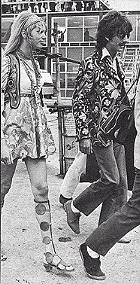
7. Purple Suede Gladiator Sandals, as seen on Jenny Boyd: This is really where the dream aspect of this list comes in. Though Jenny is the one seen here wearing them in a photoshoot, Pattie was the one who ended up with these incredible shoes, rocking them hard core during her 1967 trip to California with hubby Georgie. If anyone knows how I can get a pair on these (or even similar-yet-groovy styles), not only will you be my best friend for life, but also my personal savior.
8. Tons of DVDS, including "Wonderwall," "Magical Mystery Tour," "Troop Beverly Hills," "Lagerfeld Confidential," and "How to Steal a Million": The Jane Birkin vehicle "Wonderwall" has been quite a challenge for me to find, but I'm interested to check it out since the music was scored in Eastern fashion by George Harrison and the sets were designed in a swirl of cosmic colors by the Dutch art group The Fool. I've seen clips of "MMT" online, but YouTube just does not suffice anymore and I want to see it in it's full, critically-unacclaimed glory. Along with the Anna Wintour doc "The September Issue," the film "Lagerfeld Confidential" gives a rare glimpse at one of fashion's most enigmatic creatures, Chanel's guru Kaiser Karl. Featuring a young Jenny Lewis (of Rilo Kiley fame) and Cheers alum Shelley Long, "Troop Beverly Hills" was my absolute favorite movie for a time in my life. I absolutely abhorred the thought of joining the real Girl Scouts after discovering my Troop Mother would be nothing like Long in this movie. Also, I'm in a very Godard stage, so I'm hoping to score "Masculin Feminine," "Breathless," or "Contempt" to add to my DVD collection.

Saturday, December 12, 2009

so we beat on, boats against the current, borne back ceaselessly into the past


This is something that I had to write for my seminar class (*with slight edits*), in response to The Great Gatsby (1974):
When I was fourteen, I feel head-over-heels in love with this adaptation of The Great Gatsby. I hadn’t read the book, mind you, so my basic understanding of the story was that an adorably flighty socialite had an affair with a suave millionaire, all the while the guy from Law and Order just stood in the background. For years after that, I nursed an obsession for the costumes Ralph Lauren designed for the film, and frequently cited the movie as ‘incredible.’ Upon viewing this film again, my opinion of it has changed. No longer are the gorgeous costumes, perfect settings, and lush music blinding me into thinking that this film is without fault.
First of all, I think it says something that the first thing I loved about the film was the way it looked. It was still true for me that while I was watching it again I was struck by how beautiful everything and everyone was. Well, except for the actress who portrayed Myrtle – she sort of scared me. The film succeeded in capturing the shallow beauty of the time, but I think it relied too heavily on that, and, in doing so, it turned one of the most celebrated stories of the 20th century from a character study into a costume movie. It is an issue of style over substance.
Mia Farrow plays Daisy as a fragile, naïve wife in a jittery way that makes me imagine her as Rosemary Woodhouse, but instead of mod shift dresses and a Vidal Sassoon haircut she’s wearing flapper dresses and finger waves. I’m not sure that she was the most appropriate person to play Daisy, but she played the character well. Robert Redford is just too pretty (in a masculine way, of course) for me to believe him to be the guy from the wrong side of the tracks who is a bootlegger and swindler. If the perfect ‘All-American Man’ were to exist, it would be Robert Redford. More specifically, it would be Robert Redford as Jay Gatsby. Overlooking his appearance, he gives a pretty decent performance. My only critical note was that Redford carried himself throughout the film as a rich man, not as a newly rich man. I was intimidated by Redford’s Gatsby, not intrigued by him. Sam Waterston’s portrayal of Nick Carraway was a great performance, although not quite at all like the Nick I imagined in the book. Waterston’s Nick has this sort of wide-eyed look to him most of the time as though he is more baffled by this crowd than fascinated.
I think what keeps this film from being superb is the fact that it’s really long. The appeal of Fitzgerald’s novel is that it’s exciting and quick – just like the Roaring Twenties – all the while remaining poignant and beautiful. I think that the production team was too consumed with crafting every bit of the film to be just right that it came off being very structured and crafted. The director’s choice to make the film almost two and a half hours long makes the story seem stilted and sluggish. And there are way too many awkward silences between Daisy and Gatsby to consider theirs a torrid, passionate love. While I do respect Coppola’s efforts to translate as much of the original text into the screenplay, I thought that using so much of Nick’s narration and turning it into dialogue didn’t quite work.
I wonder if one day someone will remake this film in a way that properly honors the book. I’ve heard that Baz Luhrmann is to direct one that will be released by the end of next year, but I’m not sure if even he could capture the story’s essence appropriately. I am a great fan of his work, but I cannot imagine his preferences for Bollywood-esque sets and musical rapidity would really come off well in the lazy Long Island setting of this story. I used to have daydreams (during the brief time I imagined myself becoming a filmmaker) about making a new Great Gatsby – one that everyone would love. And to my future critics who will say its impossible for me to recapture a time almost a hundred years before, I will quote Gatsby: “Can’t repeat the past? Why of course you can!”

Sunday, November 29, 2009

i can tell you nothing new has happened since i last saw you, won't you call me miss o'dell?


"I wasn't famous. I wasn't even almost famous. But I was there." And so begins Miss O'Dell: My Hard Days and Long Nights with The Beatles, The Stones, Bob Dylan, Eric Clapton, and the Women They Loved. Phew, quite a title. But it's really only the microscopic tip of the iceberg in Chris O'Dell's rock 'n roll life. I swear, O’Dell was literally there for every major thing in rock and roll during the late sixties through the early eighties. She was far beyond just being “with the band,” she was part of the family, an insider who was trusted more than just an employee but also as a friend.
In 1968, after a chance dinner with Derek Taylor, O'Dell packed up her life in Los Angeles and moved to London to work at the Beatles' Apple offices. She palled around with the infamous Francie Schwartz and other Beatle regulars (like Mal Evans and Neil Aspinall), and hung out with some of the Hell’s Angels before becoming best friends with Pattie Boyd and eventually Maureen Starkey, who were both cold to her initially because of their jaded and untrusting view of women entering the Beatle circle after years of infidelity (Pattie recalled in her memoir Wonderful Tonight that she worried "when Chris walked in through the front door, looking like Goldie Hawn and chatting confidently with George ... I guessed he had brought her home because he intended to sleep with her"). 
She worked for Peter Asher, who was employed at Apple as the A&R manager (but by that time Paul and Jane had broken up and in only a few months would Paul marry Linda), was in the studio for recording sessions of the White Album, Abbey Road, and Let It Be, even singing backup for the chorus of “Hey Jude.” She was present for the Beatles rooftop concert and had a romance with Leon Russell, a “friend” of Bonnie and Delaney, for who he wrote the song “Pisces Apple Lady.” She delivered Bob Dylan’s harmonicas by helicopter for his comeback concert in ’69 Isle of Wight, and recalls on the flight back with John and Yoko that they were afraid they were going to crash so they all chanted Hare Krishna over and over again.
After the Beatles broke up, she lived with Pattie and George at Friar Park, helping to decorate the mammoth house, typing the lyrics for George’s album All Things Must Pass, and aiding in the organization of the Concert for Bangladesh. She was also there when Harrison had to read in the newspaper that the Beatles were kaput, over his cup of morning tea. Harrison wrote the wonderful (and greatly underrated, if I might add) song “Miss O’Dell” for her after she was supposed to hang out with him in Malibu one night but then blew him off. The song became a B-side for “Give Me Love (Give Me Peace on Earth),” and is where the book’s title comes from.
After that, she worked as a P.A. for the Rolling Stones on their 1972 tour, where she became good friends with Bill Wyman’s wife Astrid, slept with Mick Jagger, and did a drug run for Keith Richards, who she fondly remembers as a sweetheart with a bad boy exterior. In Stones circles, she is the “mystery woman” on the cover of Exile on Main Street.
She worked as a tour manager, working with Bob Dylan on his Rolling Thunder Revue Tour, and became entangled in yet another love triangle with filmmaker Sam Sheppard and Joni Mitchell (becoming immortalized as the “woman down the hall” in Mitchell’s song “Coyote”) before having an affair with Bob Dylan himself. After working with who she called “The Big Three” – The Beatles, The Stones, and Dylan – O’Dell continued her work as one of the only female tour managers out there by working with (to name a few) Crosby, Stills, Nash & Young; Fleetwood Mac; Earth, Wind and Fire; Queen; Linda Ronstadt; Santana; Phil Collins; and ELO.
She ended her legendary career in the eighties after working with Echo and the Bunnymen, whom she doesn’t really have much to say about. At the point in her life when rock music was only a shadow of what it once was, Chris decided to find something else. She attended a party given by her very good friend Astrid Wyman in the south of France, and met the man that would become her husband, the Honourable Anthony John Mark Russell, a nobleman who was the son in an eccentric British family belonging to the House of Lords. She had a son, William, whose godparents were Ringo Starr and Pattie Boyd (natch…) and who is now in his early twenties. She gave up alcohol and drugs, and eventually moved back to Tucson after divorcing her first husband, becoming a counselor and hypnotherapist specializing in addiction and recovery. Her story comes full circle with her move back to Tucson. O’Dell spent much of her life after moving away from Arizona gravitating back and forth between London, Los Angeles, New York City, and Germany, finding homes in all those places but never truly settling down. Well O’Dell got back to where she once belonged, so to speak, when she moved back to her childhood home, and set up a life for herself there for nearly 20 years.
I prefer this book almost more than others from the same era because it is real. O'Dell has no reason to lie - she doesn't have a mythic persona or reputation to uphold, she's just a person who was lucky enough to experience all of these things and has no reason to lie or hold back on any account. This book is more relatable for a simple gal like me than say Wonderful Tonight or Faithfull, where even though the lifestyle and fame that Boyd and Faithfull achieved was unexpected by them when they first began their respective relationships with Harrison and Jagger, they garnered certain levels of fame and exposure in their careers prior to that. Chris O'Dell was a young girl (only 20 years old when her entire life changed) working in Los Angeles with no designs of fame and no reason to believe she would become intimately closer to rock stars than what her daydreams allowed.
Whereas Wonderful Tonight treated certain events (like excessive cocaine use and infidelity), as something best not relived in too much detail, Miss O'Dell gives equal treatment to every event in her life. The long-lasting pain of the George-Maureen-Ringo love triangle and the Eric-Pattie-George love triangle, (and also reveals the Maureen-Ringo-and herself triangle) are discussed and it is reveals that they merged together to create some sort of love ... rhombus, consisting of George, Maureen, Ringo, Pattie, Eric, and Chris herself. She writes of the moment in Ringo’s kitchen when in the middle of conversation with Mo and Pattie, George casually turned to Ringo and said, “You know, Ringo, I’m in love with your wife.” Ringo responded after a pause, “Better you than someone we don’t know.” After that admission, Starr took solace in Los Angeles with O’Dell for several months. A time later, Maureen confronted Chris about their affair and after she came clean (much to Ringo’s dismay) they managed to salvage their friendship and remained close until Maureen’s death in 1994.
Part of the book chronicles the demise of the Harrison marriage, as O’Dell was witness to Pattie’s affairs with Clapton and Ronnie Wood, and George’s affair with Mo Starkey and his rapidly changing mood swings (she writes of a joke that Pattie and her shared during that time that they didn’t know each day if George would have his hand in the prayer bag or the coke bag) and his deep preoccupation with religion and discovering purpose. Her chronicling of it is almost more in-depth than Boyd’s and Clapton’s combined as she was not as romantically entangled and was able to see all parties affected.
O'Dell also doesn't hold back about her drug usage and writes about it for what it was - addiction. She writes casually of snorting lines with George and Pattie at Friar Park in between billiard games, and remarks of her excitement when Keith Richards sent her from Dallas to LA to get some "really great" coke while on tour. Several times throughout her life, O’Dell worried that she was hitting rock bottom, but she found that once you hit the bottom there was always a trap door there waiting to take you lower. Substance abuse is a common thread throughout the book, both in the people she worked for and in her own life.
She gives equal treatment to characters in her life as well. Instead of indulging into salacious details of her romantic relationships with Ringo Starr, Mick Jagger, Jim Gordon, Leon Russell, and Bob Dylan, she treats the bedroom happenings with a certain level of ambivalence, instead focusing on the backstage conversations she had with them. Also, she writes a lot about the people in her life that another person maybe wouldn't remember or give more than a few sentences about. She talks openly and unabashedly about the crushes she had on tours, and there is a darling scene between her and a young Cameron Crowe, whose wide-eyed innocence and honest love of music captured O'Dell's appreciation. She gives more treatment to her relationships with the wives of rock stars, with whom she was best friends with. She writes at length of the turmoil she was in when she thought that one of her actions would offend Pattie or Mo, as she knew that it took a lot for these women to trust people around them. A lot is written about her friendship with Pattie, and how with George she was welcomed as a member of the family but with Clapton she was treated as a competitor for Pattie’s attention and affection.
Miss O’Dell is a really remarkable book, one so interesting it’s almost hard to believe this all happened to a little girl from Tucson. It’s honest and real, the only thing we can ever really ask for in a memoir. She doesn’t sugarcoat, sensationalize, romanticize, or demonize (or any other –ize, for that matter) fame and fortune. She presents it for what it was in that moment in time. Miss O’Dell is the ultimate backstage pass into a world of rock and roll that most of us can only see in magazines and on vinyls.

Thursday, June 11, 2009

Good Read - Clapton

Eric Clapton’s autobiography “Clapton” is one of the best rock autobiographies ever written. It is an immensely personal book, one that starts depressing and just gets worse as you read it. Yes, like all other memoirs of the sixties, Clapton talks a lot about the decadent sex, drugs, and rock ’n roll during that time, but he talks about the sex that destroyed his relationships, the drugs that nearly destroyed his life, and the rock ‘n roll that he sometimes had to fight to be a part of. Clapton goes back to the beginning, retracing every step he took to get from the being an abandoned child of the war living with his grandparents to becoming ‘God.’ He talks about his stints in the Yardbirds, Cream, as a solo artist, and his relationships with fellow musicians (particularly enjoyable was Clapton’s panic stricken introduction to Jimi Hendrix, who Clapton worried about because his playing was ‘the real deal’). Clapton isn’t shy to talk about his love affairs and drug use, going into great detail to describe his multiple addictions and his turbulent affair with Pattie Boyd (wifey of his good friend George Harrison, but if you've been on this site before, of course you already know that). Clapton also recounts his long road to recovery, discussing his struggle to find faith, and the death of his young son Conor.
The good thing is that Clapton made some mistakes in his life, and he more than owns up to them in the book. He even takes the blame for things that weren’t his fault. He admits to his indulgence in the over-the-top sixties, but also seeks redemption for past mistakes. He is funny and witty, yes, possessing the humor of someone who has seen almost too much in life. All in all it’s a very thorough look at a musician who has still remained an enigma in music history.

Sunday, February 1, 2009

Good Read - The Philosophy of Andy Warhol (From A to B and Back Again)

This incredibly funny and incredibly Warhol book, released in 1975, is more like a collection of quotations that just happen to relate to whatever the chapter is dedicated to as opposed to an actual memoir or story. But the brilliance of this book is that Warhol offers his succinctly ironic opinions on a number of topics (love, fame, fortune, sex, food, beauty, work, art, success, death), which in turn reveal a little more about this mysterious man. At times he seems to possess a naïve outlook of the world, at others he seems in on some dirty joke that none of us understand. For much of the book, he retains his stylishly aloof, über-cool attitude, only occasionally revealing to us his darker inner thoughts. Numerous times he refers to his 1968 shooting by Valerie Solanas, discussing his emotional and physical scars and his newfound awareness of his own mortality. It’s when he discusses this (either directly or indirectly) does Warhol offer startling real insights on the human condition. He describes his embarrassment of death and in terms of human perception, “it’s not what you are that counts, it’s what they think you are.” He discusses pop culture and celebrity in terms that make involvement or obsession with it seem understandable and beautiful. Throughout the book, Warhol includes fragmented conversations (most with Brigid Berlin) and short biographies of other people (written using aliases), such as the story of his former friend Edie Sedgwick, who he dubbed “Taxi.” This particular part of the book is especially revealing because as much as Warhol publicly denied being close at all with Sedgwick, in his writing of her, he says their relationship “was probably close to a certain kind of love.”
Even though his ideas and life seemed out-there for many conservatives, Warhol is just about as symbolically American as the Coca-Cola, Campbell’s soup, baseball, and Hollywood stars he made his career out of. As influential and masterful as his films and paintings, Warhol’s “Philosophy” of life may be one of his greatest achievements.

Saturday, January 31, 2009

Good Read - Dandelion: Memoir of a Free Spirit

Raised by a mother who makes Joan Crawford look loving and an alcoholic absentee father (later fond of gender-bending), Catherine James always dreamed of breaking free from her family’s control over her. Throughout her childhood, Catherine was abused physically and emotionally by her mother, a shamelessly destructive and self-involved woman who believed that socializing with the Los Angeles elite to be more important than raising her young child. James recounts times when her mother would tie her to a chair or lock her in a closet before she went out in order to keep her daughter out of “harm’s way,” or would feed Catherine stale rotting food doused in Tabasco sauce for dinner. The abusive relationship Catherine has with her mother becomes the pattern for every relationship to come – time and time again, she is left emotionally pummeled by the person closest to her. But even still, James’s optimism remains and she can find the silver lining in the more heartbreaking of experiences.
By twelve Catherine James was declared a ward of the state, living in an orphanage. At a performance in Santa Monica, she had a chance meeting with a 22-year-old Bob Dylan, the first person to really inspire her to break out. And break out she did. In 1964, Catherine moved to Greenwich Village to seek out her new mentor when she was only 14 years old. Soon enough she was partying with rock stars and landed herself a screen test with Andy Warhol. When she was sixteen, she became involved with Denny Laine (of the Moody Blues, Airforce, and Wings) and moved with him to London where she had a son with him, Damian James. For a while when Laine comes into the picture, we think that he is Prince Charming here to save our damsel in distress; he treats her well, takes her partying with the Beatles, the Who, and the Rolling Stones, but soon his own abusive nature is revealed and our dear Catherine is forced to endure more torment from someone she loves. She finally leaves him, moving with her son back to California and enjoying a romance with Jackson Browne, but is lured back to London by Laine, who promises he has changed and wants them to raise their son together. After a few blissful months together, their relationship once again becomes abusive and she one again leaves him. By nineteen, James is living (platonically) with Eric Clapton, cooking his meals and aiding him through his then-unrequited obsession with Pattie Boyd. She also enjoyed dalliances with Jimmy Page throughout the seventies while she lived in Connecticut with her son and became a model for Wilhelmina.
The memoir of a child living in an adult world, the story of Catherine James’s life is a compelling one. Through all the heartbreak that she lived through, “Dandelion” does not wallow in past unhappiness but shines with the author’s sweet optimism. James’s journey to find love and flee abuse is so that at times it reads like fiction. I believe Miss Pamela (authoress and memoir-extraordinaire of “I’m With the Band” and “Let’s Spend the Night Together”) said it best with, “‘Dandelion’ tells the courageous nine-lives tale of an exquisite beauty’s great escape from a turbulent childhood, free-fall into the revolutionary rock music scene, a child raising her own child amidst chaotic upheaval. Audacious and dauntless, Catherine James maintains her sweetness and vulnerability, even when facing down her demons. From the Hollywood heyday to swinging Mod London, to the streets of Greenwich Village and back again, she takes us to shadowy and brilliant places, introduces us to ghastly and illustrious characters, sprinkling heartfelt wisdom and insight on every page.”

Wednesday, January 28, 2009

Good Read - I Me Mine

Okay, this is more of Harrison’s insight on and inspiration surrounding the many songs of his career than a real memoir, but this is the closest we have to any Beatle writing an autobiography. The introduction, written by his widow Olivia, is a tender and personal look at what Harrison (and his music) meant to others. Featuring the personal copies (and the revisions) of over eighty of Harrisons songs, “I Me Mine” also includes archival photos of the great man during different periods of his life (with amusing captions to go along with them), and a brief “biography” of his life. But this book is more about Harrison’s music (and at times, religious beliefs), not him self. I think that this is just one indication of how not conceited George Harrison was – never considering the self as being important, just the things we do in life. Before his death in 1980, John Lennon openly expressed unhappiness that Harrison only mentioned his names a handful of times throughout the book. Lennon considered himself as an influence and aid to his former band mate when Harrison was establishing himself as a songwriter and lacked Lennon’s experience or wordplay skill. But Lennon apparently failed to realize that his name was mentioned more times than Ringo’s name, Paul’s, or George’s first and second wives combined. But that was just George’s nature, I suppose, though it’s a shame that his reserve and discretion over personal details caused his former collaborator to think that he undervalued their partnership. In the bits that George does write, his dry and deprecating sense of humor soaks through. For the song “Blue Jay Way,” inspired by Derek and Joan Taylor’s now-infamous tardiness, he writes: “the mood is also slightly Indian. Derek Taylor is slightly Welsh.” He is quick to dismiss songs like “Don’t Bother Me,” saying he didn’t “think it’s a particularly good song, it mightn’t even be a song at all”; calls “Beware of Darkness” as having a melody that’s “sort of strange”; finds fault that “So Sad,” written while he was splitting up with Pattie, “is depressing, it is so sad.” He even rewrote the bridge to “I Want to Tell You” to suit what he felt the song was truly communicating. Published over two decades before his death, “I Me Mine” still remains a perfect account of Harrison’s life, worthy to read if even just to hear the Quiet Beatle in his own words. And who would not be enticed by his introduction, which states, “I have suffered for this book; now it’s your turn.”

Good Read - Faithfull: An Autobiography

I am honestly fascinated/enamored/in awe of the life Marianne Faithfull has lived. Her story – marked by addictions, glamour, great successes, and even greater tragedies – resembles more of a Thomas Hardy novel than someone’s autobiography. As heartbreaking and unbelievable Faithfull’s story is, it is her story, and it is the truth; she emerges as Hardy’s romantic heroine of the Swingin’ Sixties. In comparison to the any number of memoirs written about the sixties, Faithfull’s book is far and away the most tragic of the bunch. After reading this rather emotionally-draining tale that could’ve encompassed four or five lifetimes, it’s hard to believe she was only 47 when this was published. Growing up in a strict Roman Catholic household, Faithfull was a child of divorce whose early years were marked by attacks of tuberculosis and poverty. After leaving school at seventeen, Marianne found success as a folk singer in London. Just as her singing career took off (her first single, “As Tears Go By,” released in mid-1964), she married John Dunbar in 1965 and had a son six months later. It was during this time she began hanging out with such luminaries as Bob Dylan and the Rolling Stones. At this point in the book, Marianne reveals her romantic entanglements with Dylan, Jagger, Richards, and Brian Jones. She also admits that although she was an international superstar, her artistic input over her image and her music slowly diminished; she continually rejected the innocent, angelic image the press and her music label forced on her. After recounting her reign as pop princess, Faithfull switches gears to describe her downfall – her breakup with Mick, her deeper descent in drugs, her loss of custody rights over her son, several suicide attempts, and her eventual homelessness during the Seventies and eighties. This part of the book is easily the most depressing – her many misfortunes are rarely offset by luck in Ms. Faithfull’s life (apart from her comeback of sorts in “Broken English”). A strength I found in Faithfull’s book is that she admits all her mistakes, at times taking more blame than I believed she deserved. She describes herself as a victim of cool, both indulgently describing and mocking the hedonistic nature of the 1960s, the “free love, psychedelic drugs, fashion, Zen, Nietzsche, tribal trinkets, customized Existentialism” that was so much a part of her life. The maturity Ms. Faithfull possesses is apparent when reading her reflections on her youth. She gives balanced and personal descriptions of Bob Dylan, the Beatles, Allen Ginsberg, Anita Pallenberg, and the Rolling Stones, most touchingly of Mick Jagger. She doesn’t describe their relationship in terms of sensationalism – it seems like a genuine relationship of young love, recounting the ups, the downs, the headiness, the detachment, the romance and the melancholy that comes from a true love affair. It was her ironic and dry sense of humor that saved this book from becoming the most depressing book ever written. An example of her wit was when she contemplated, “Who was the great love of [Mick Jagger’s] life? Actually, I think it was Keith.” And in the end, realizing her story was far from complete at only 47 years old, Faithfull ends her book with a set of cooking recipes and tips.

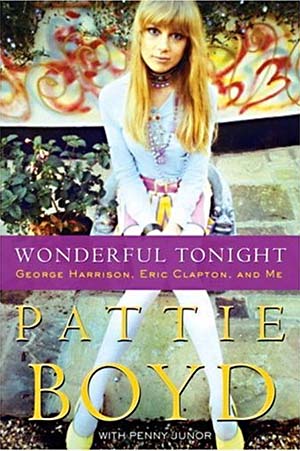
Good Read - Wonderful Tonight: George Harrison, Eric Clapton, and Me

This is one of my favorite autobiographies by anyone in the sixties --- not because of the writing (which, at times, is less than superb...example: "We were all out on the town; we were young, we were gorgeous, everything was fabulous".... not exactly Hemingway…), but because of the essence of the story. I am not shy about my love for Pattie Boyd, so when she released her autobiography in late 2007 I was incredibly excited to say the least. It was rumored that Ms. Boyd wrote her account in order to dispel/compete with things that Eric Clapton’s autobiography (also released in late 2007) would claim; both Boyd and Clapton’s accounts match up for the most part (overlooking the George & Eric guitar duel for her honor that Pattie writes about). My favorite part of the book is about her and George’s happier times. She writes about their shy courting sessions on set of “A Hard Day’s Night,” their Tahitian vacation with the Lennons, and just hanging out at their honeymooner home Kinfauns. Things start to go downhill as George becomes more and more immersed in religion and music – oftentimes leaving Pattie alone for hours, days – and selling Kinfauns in favor of the gothic mansion Friar Park without even telling Pattie beforehand. This, alongside George’s philandering and Pattie’s growing relationship with Eric Clapton, led to some of the more heartbreaking chapters of this book. When Pattie tells her husband she’s leaving him to go on tour with Eric in the US, George’s quiet and solemn cry for her to “Please don’t leave” quite literally brought tears to my eyes. The next chapters of the book are even more depressing as Pattie recounts her new beau’s spiraling addictions and how helpless she felt to save him from himself. She also describes how Eric’s many affairs – most notably the conception of his son Conor with another woman – caused her to realize that the years of adoration and devotion Eric pledged to her while she was married to George were just the thrill of the chase for Eric. Though written with the aid of a ghostwriter, Pattie’s book is still immensely personal. It is obvious she hasn’t overcome the pain her second husband put her through, and views her leaving George as ‘the greatest regret of [her] life,’ who she now sees as her soul mate. I think that everyone should read this book, if not just to get a greater understanding of one of the most infamous love triangles in history. With “Wonderful Tonight,” Pattie proves she’s still got us own our knees.

Wednesday, January 21, 2009

Good Read - What Falls Away

So much talk has followed Mia Farrow all her life -- from her childhood as the daughter of two industry veterans, her rise to stardom on "Peyton Place" at 19, her controversial marriage to Frank Sinatra at 21, to her 12-year creative relationship with Woody Allen (and we all know how that ended...). Mia's memoir serves to cut away all the gossip that has surrounded her life and tell what really happened. Mia comes off sounding very compassionate, intelligent, but also with a bit of the naïveté of her most famous role, Rosemary Woodhouse. After reading, I felt like the goal in Ms. Farrow's book was the provide her truths -- she presented what happened, not necessarily how she felt about it. She didn't use the book to diminish Woody Allen's reputation and her portrayal of him was quite fair, all things considered. She also spent quite a bit of the book talked about her experiences with adoption and with her children. She also explains that her upbringing as one out of seven children influenced her fifteen adoptions of children from all over the world. Mia is not shy to own up to the mistakes she made over the years, not using her book to deflect responsibility. She admits that she was always rather passive and vulnerable by nature, and in the end, she hints that maybe these qualities have not been overcome. In a sense, what falls away in this book are the falsities and rumors that have surrounded Ms. Farrow for her sixty-plus years and we are allowed to see clearly the remarkable, beautiful person that she is.
Related Posts Plugin for WordPress, Blogger...