


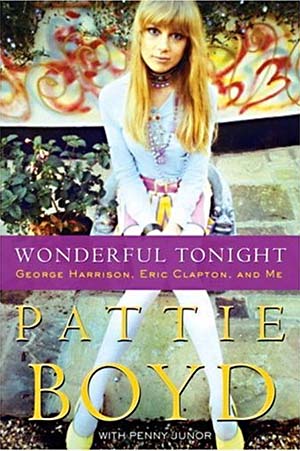
 This is one of my favorite autobiographies by anyone in the sixties --- not because of the writing (which, at times, is less than superb...example: "We were all out on the town; we were young, we were gorgeous, everything was fabulous".... not exactly Hemingway…), but because of the essence of the story. I am not shy about my love for Pattie Boyd, so when she released her autobiography in late 2007 I was incredibly excited to say the least. It was rumored that Ms. Boyd wrote her account in order to dispel/compete with things that Eric Clapton’s autobiography (also released in late 2007) would claim; both Boyd and Clapton’s accounts match up for the most part (overlooking the George & Eric guitar duel for her honor that Pattie writes about). My favorite part of the book is about her and George’s happier times. She writes about their shy courting sessions on set of “A Hard Day’s Night,” their Tahitian vacation with the Lennons, and just hanging out at their honeymooner home Kinfauns. Things start to go downhill as George becomes more and more immersed in religion and music – oftentimes leaving Pattie alone for hours, days – and selling Kinfauns in favor of the gothic mansion Friar Park without even telling Pattie beforehand. This, alongside George’s philandering and Pattie’s growing relationship with Eric Clapton, led to some of the more heartbreaking chapters of this book. When Pattie tells her husband she’s leaving him to go on tour with Eric in the US, George’s quiet and solemn cry for her to “Please don’t leave” quite literally brought tears to my eyes. The next chapters of the book are even more depressing as Pattie recounts her new beau’s spiraling addictions and how helpless she felt to save him from himself. She also describes how Eric’s many affairs – most notably the conception of his son Conor with another woman – caused her to realize that the years of adoration and devotion Eric pledged to her while she was married to George were just the thrill of the chase for Eric. Though written with the aid of a ghostwriter, Pattie’s book is still immensely personal. It is obvious she hasn’t overcome the pain her second husband put her through, and views her leaving George as ‘the greatest regret of [her] life,’ who she now sees as her soul mate. I think that everyone should read this book, if not just to get a greater understanding of one of the most infamous love triangles in history. With “Wonderful Tonight,” Pattie proves she’s still got us own our knees.
|
|---|
|
|---|
Wednesday, January 28, 2009
Good Read - Wonderful Tonight: George Harrison, Eric Clapton, and Me
This is one of my favorite autobiographies by anyone in the sixties --- not because of the writing (which, at times, is less than superb...example: "We were all out on the town; we were young, we were gorgeous, everything was fabulous".... not exactly Hemingway…), but because of the essence of the story. I am not shy about my love for Pattie Boyd, so when she released her autobiography in late 2007 I was incredibly excited to say the least. It was rumored that Ms. Boyd wrote her account in order to dispel/compete with things that Eric Clapton’s autobiography (also released in late 2007) would claim; both Boyd and Clapton’s accounts match up for the most part (overlooking the George & Eric guitar duel for her honor that Pattie writes about). My favorite part of the book is about her and George’s happier times. She writes about their shy courting sessions on set of “A Hard Day’s Night,” their Tahitian vacation with the Lennons, and just hanging out at their honeymooner home Kinfauns. Things start to go downhill as George becomes more and more immersed in religion and music – oftentimes leaving Pattie alone for hours, days – and selling Kinfauns in favor of the gothic mansion Friar Park without even telling Pattie beforehand. This, alongside George’s philandering and Pattie’s growing relationship with Eric Clapton, led to some of the more heartbreaking chapters of this book. When Pattie tells her husband she’s leaving him to go on tour with Eric in the US, George’s quiet and solemn cry for her to “Please don’t leave” quite literally brought tears to my eyes. The next chapters of the book are even more depressing as Pattie recounts her new beau’s spiraling addictions and how helpless she felt to save him from himself. She also describes how Eric’s many affairs – most notably the conception of his son Conor with another woman – caused her to realize that the years of adoration and devotion Eric pledged to her while she was married to George were just the thrill of the chase for Eric. Though written with the aid of a ghostwriter, Pattie’s book is still immensely personal. It is obvious she hasn’t overcome the pain her second husband put her through, and views her leaving George as ‘the greatest regret of [her] life,’ who she now sees as her soul mate. I think that everyone should read this book, if not just to get a greater understanding of one of the most infamous love triangles in history. With “Wonderful Tonight,” Pattie proves she’s still got us own our knees.

Wednesday, January 21, 2009
Good Read - What Falls Away
 So much talk has followed Mia Farrow all her life -- from her childhood as the daughter of two industry veterans, her rise to stardom on "Peyton Place" at 19, her controversial marriage to Frank Sinatra at 21, to her 12-year creative relationship with Woody Allen (and we all know how that ended...). Mia's memoir serves to cut away all the gossip that has surrounded her life and tell what really happened. Mia comes off sounding very compassionate, intelligent, but also with a bit of the naïveté of her most famous role, Rosemary Woodhouse. After reading, I felt like the goal in Ms. Farrow's book was the provide her truths -- she presented what happened, not necessarily how she felt about it. She didn't use the book to diminish Woody Allen's reputation and her portrayal of him was quite fair, all things considered. She also spent quite a bit of the book talked about her experiences with adoption and with her children. She also explains that her upbringing as one out of seven children influenced her fifteen adoptions of children from all over the world. Mia is not shy to own up to the mistakes she made over the years, not using her book to deflect responsibility. She admits that she was always rather passive and vulnerable by nature, and in the end, she hints that maybe these qualities have not been overcome. In a sense, what falls away in this book are the falsities and rumors that have surrounded Ms. Farrow for her sixty-plus years and we are allowed to see clearly the remarkable, beautiful person that she is.
dear sir or madam, will you read my book? it took me years to write, will you take a look?
 I always thought it was a bit premature every time someone would release their autobiography. The whole point of a biography concept is to offer a complete account of someone’s life. Releasing an autobiography is like telling the world “forget my remaining years, the ones I wrote about are the only ones that truly matter.” I mean you wouldn’t write a review of a movie without seeing the last thirty minutes, right?
If a person feels so compelled to write their life’s story, why not write their memoirs like Mia Farrow did? In her own little way she was telling the world “Aha see, I’m still around; don’t know if I’ll adopt another kid because I DIDN’T WRITE AN AUTOBIOGRAPHY – MY LIFE ISNT SET IN STONE. Maybe I will, maybe I won’t – you should read my second memoir though, its all about kids 8-19.”
I think that if I ever were to write my autobiography, I would kill myself right after it went to press. (A) It would assure my book would receive tons of publicity; (B) I wouldn’t have to deal with that awkward “oh, you’ve lived such an exciting and interesting life. Well, not so much nowadays, but at one point…”
I don’t know what set me off on this tangent – maybe the news that Keith Richards is writing his own biography of his life. Even that in and of itself is sort of strange. I don’t mean to criticize – I love the man dearly and will purchase his book the instant it comes out, but I doubt he was one to keep a diary, and do you think that after all these years/drugs he will remember anyways?
I’ll admit though, I do enjoy reading autobiographies – its much more intimate than reading a biography which cites other peoples’ opinions and perceptions of events. So I guess this is one of the many contradictions of my personality – I take great delight in doing the very things I criticize. In my next posts, I will write about my favorite autobiographies/memoirs.
Monday, January 19, 2009
The Pattie Chronicles: 1965-1966 Style
During this period, Pattie began experimenting with her style more. She grew out her hair and started to grow out of her mod style. George’s rocker look began to rub off on her and Pattie began wearing daring patterns, shorter skirts, and favored more bold colors for her wardrobe.
 The essentials: pea coats in white, green, mauve (but more if you choose!), knee-length black velvet coat with a tie at the waist, shift dresses in geometric patterns, knit berets, white bikinis (worn on her honeymoon) and a deep tan (natural, of course), minidresses that had long sleeves and somewhat a boat neck, plaid button down shirts, striped shirts and sweaters, and sandals as opposed to heels
Hairstyle: Pattie, instead of her blunt bangs, wore softer side-swept bangs most of the time. Her hair was longer overall as well – instead of hanging just below her shoulders, it now hung to her shoulder blades (if you were to look from behind. In front, her hair would be about boob length). She also let her hair hang more naturally – instead of doing a flip at the ends, her hair now hung straight, sometimes with a wave overall
 The essentials: pea coats in white, green, mauve (but more if you choose!), knee-length black velvet coat with a tie at the waist, shift dresses in geometric patterns, knit berets, white bikinis (worn on her honeymoon) and a deep tan (natural, of course), minidresses that had long sleeves and somewhat a boat neck, plaid button down shirts, striped shirts and sweaters, and sandals as opposed to heels
Hairstyle: Pattie, instead of her blunt bangs, wore softer side-swept bangs most of the time. Her hair was longer overall as well – instead of hanging just below her shoulders, it now hung to her shoulder blades (if you were to look from behind. In front, her hair would be about boob length). She also let her hair hang more naturally – instead of doing a flip at the ends, her hair now hung straight, sometimes with a wave overall
Sunday, January 4, 2009
The Lovely Linda

Growing up, Linda McCartney was my idol. My first real exposure to her was on an episode of “The Simpsons” I watched with my older brother when I was around five years old. Her and Paul made voiced “guest appearances” on the show where they spread the message of vegetarianism. This episode caused my taste for meat to decrease greatly and I think it was one of the earliest things that influenced my decision to give up meat permanently only five years later.
Mrs. McCartney (who was born Linda Eastman) continued to influence my life as I grew older. My mother, a former photographer, had tons of books containing the work of other photographers, one of them being Linda (I believe it was her “Portrait of an Era” book, but I cannot find it anywhere in our house right now). I admired her intimate style of photography; her work never seemed stiff or posed, it looked as though she had captured a spontaneous moment of a close friend. Linda’s photography has become world-known, especially in the rock’n’roll community, as she took famous images of The Rolling Stones, Jimi Hendrix, Bob Dylan, Aretha Franklin, Janis Joplin, Simon and Garfunkel, Neil Young, The Doors, The Who, and of course, The Beatles. A portrait taken of Eric Clapton in 1968 marked the first time a photo taken by a woman had graced the cover of “Rolling Stone” magazine. I picked up photography as hobby about four years ago, and I think that Linda’s portfolio has influenced my style. Like she, I tend to photograph members of my family particularly when we are outside in a very natural, earthy setting. About photography, Linda once said it “made me a different person because it was something I loved doing and just nothing else mattered. I could just taken my camera and go, probably like Diane Arbus felt when she was taking pictures. I had that feeling…I could just go, go anywhere.”
Her close and almost down-to-earth style of photography mirrored her unpretentious and warm personality. Paul described their relationship in “Many Years From Now” as always being “very close…It was a great change in my life, I've always had quite serious relationships, I didn't have that many women. I had girlfriends and one-night stands a lot, the swinging sixties, sexual revolution. But this was the start of this new kind of relationship for me. I found it very liberating” to be with Linda. Although she was born into a very wealthy family, Linda insisted on making her own income and having her own career, a belief she carried through her marriage to McCartney. She was also the one to insist her and Paul spend time in the countryside with their children, believing that it was necessary to retreat from the world and build a nest together. The family (Paul, Linda, Heather, Mary, James, and Stella) lived in a three-bedroom house because as Paul said, “Linda and I agreed that to have a successful family, we intended to live on top of each other.”
My parents are ex-hippies, so they grew up with Beatlemania and the after-years, and made the music they grew up with an integral part of my youth. I remember dancing along to my mom’s original Wings albums and thinking it was so cool that this girl from New York had made it into a British super-group. Linda, who openly said that she never desired a music career and only joined Wings at Paul’s insistence, performed keyboards and vocals during the band’s decade-long tenure. She also co-wrote some of the band’s biggest hits her with husband; both she and Paul were nominated for an Oscar for their song “Live and Let Die,” and Wings won many Grammy awards throughout the 70s. Despite the many successes Wings had, Linda still had to put up with jibes about her newfound musical career and criticisms about her singing being out-of-tune. Linda apparently told her close friend Danny Fields, (as repeated during the A&E Biography of the Beatles’ Women) “I don’t want to be here, I want to be home with the horses and the children and the garden. I can’t play piano – everyone knows it. They laugh at me, they write about me, they make fun of me.” But eventual as her musical talents grew, Linda was able to make light of her inexperience, calling her singing sub-par in the beginning and claiming that in terms of her piano-playing, “there’s high-schoolers who could do better.” For me, a child with no musical abilities, Linda represented what I thought was impossible – even though she had to endure all those rude remarks about her singing, she still won many Grammys and other awards – because of Linda, I could now add international rock star to my list of possible careers. So deep was my respect for Linda, I even accepted the fact that she was married to my future-husband Paul because I understood she was a good person, which was no easy feat for a lovelorn seven-year-old.
Linda McCartney was also an outspoken activist, particularly for animal rights, lending her support to organizations like PETA, Friends of the Earth, LACS, among others. She also was a vegetarian for the majority of her life. Of her meatless lifestyle, Linda said that she wouldn’t “eat anything with a face” and said that if more people understood the goings-on of slaughterhouses, “the whole world would be vegetarian.” After introducing her husband to vegetarianism in 1975, she founded a business with hopes of further promoting vegetarianism. She started the Linda McCartney Foods company, where she published many cookbooks containing only meatless recipes and sold frozen vegetarian meals; both endeavors proved to be very successful and made Linda financially independent from Paul.
In 1995 Linda was diagnosed with breast cancer, losing her battle with the disease three years later. She passed away in April 1998 at only 56 years old. I remember the day Linda McCartney passed away – as pathetic as this may sound, her passing was my first real encounter with death and it absolutely devastated me. I may have only been a child, but the genuine feelings of melancholy were not lost on me. Even though I didn’t know her, I felt like I had lost someone who was very much present in my life. The ways in which Linda presents herself in my life unfortunately does not exclude breast cancer – both my mother and grandmother have been diagnosed with cancer in the last four years, and I live with the possibility of inheriting the disease.
In a lot of ways, I can relate to Linda and look to her as my role model. She proved herself to be an esteemed and talented photographer who succeeded in making a name for herself apart from the merits of her husband’s work. She also was an animal rights activist who spread the benefits of a meatless lifestyle with the world, and was probably the most famous reluctant rock star of the twentieth century. In her honor, PETA created the Linda McCartney Memorial Award after her passing in order to commemorate those who make strides to protect animal rights. Linda also inspired some of her husband’s most tender love songs, including: “The Lovely Linda,” “Maybe I’m Amazed,” “I Will,” “I’ve Got a Feeling,” “Two of Us,” and “My Love.” Paul McCartney also said that after Linda was diagnosed with cancer, the meaning of his song “Little Willow” – originally dedicated to Maureen Starkey, the late first-wife of Ringo Starr – also became true for Linda. Rest in peace Linda; your wonderful legacy lives on through your activism, your photography, and the lessons you taught your four children and husband, who all still carry on your message.
Her close and almost down-to-earth style of photography mirrored her unpretentious and warm personality. Paul described their relationship in “Many Years From Now” as always being “very close…It was a great change in my life, I've always had quite serious relationships, I didn't have that many women. I had girlfriends and one-night stands a lot, the swinging sixties, sexual revolution. But this was the start of this new kind of relationship for me. I found it very liberating” to be with Linda. Although she was born into a very wealthy family, Linda insisted on making her own income and having her own career, a belief she carried through her marriage to McCartney. She was also the one to insist her and Paul spend time in the countryside with their children, believing that it was necessary to retreat from the world and build a nest together. The family (Paul, Linda, Heather, Mary, James, and Stella) lived in a three-bedroom house because as Paul said, “Linda and I agreed that to have a successful family, we intended to live on top of each other.”
My parents are ex-hippies, so they grew up with Beatlemania and the after-years, and made the music they grew up with an integral part of my youth. I remember dancing along to my mom’s original Wings albums and thinking it was so cool that this girl from New York had made it into a British super-group. Linda, who openly said that she never desired a music career and only joined Wings at Paul’s insistence, performed keyboards and vocals during the band’s decade-long tenure. She also co-wrote some of the band’s biggest hits her with husband; both she and Paul were nominated for an Oscar for their song “Live and Let Die,” and Wings won many Grammy awards throughout the 70s. Despite the many successes Wings had, Linda still had to put up with jibes about her newfound musical career and criticisms about her singing being out-of-tune. Linda apparently told her close friend Danny Fields, (as repeated during the A&E Biography of the Beatles’ Women) “I don’t want to be here, I want to be home with the horses and the children and the garden. I can’t play piano – everyone knows it. They laugh at me, they write about me, they make fun of me.” But eventual as her musical talents grew, Linda was able to make light of her inexperience, calling her singing sub-par in the beginning and claiming that in terms of her piano-playing, “there’s high-schoolers who could do better.” For me, a child with no musical abilities, Linda represented what I thought was impossible – even though she had to endure all those rude remarks about her singing, she still won many Grammys and other awards – because of Linda, I could now add international rock star to my list of possible careers. So deep was my respect for Linda, I even accepted the fact that she was married to my future-husband Paul because I understood she was a good person, which was no easy feat for a lovelorn seven-year-old.
Linda McCartney was also an outspoken activist, particularly for animal rights, lending her support to organizations like PETA, Friends of the Earth, LACS, among others. She also was a vegetarian for the majority of her life. Of her meatless lifestyle, Linda said that she wouldn’t “eat anything with a face” and said that if more people understood the goings-on of slaughterhouses, “the whole world would be vegetarian.” After introducing her husband to vegetarianism in 1975, she founded a business with hopes of further promoting vegetarianism. She started the Linda McCartney Foods company, where she published many cookbooks containing only meatless recipes and sold frozen vegetarian meals; both endeavors proved to be very successful and made Linda financially independent from Paul.
In 1995 Linda was diagnosed with breast cancer, losing her battle with the disease three years later. She passed away in April 1998 at only 56 years old. I remember the day Linda McCartney passed away – as pathetic as this may sound, her passing was my first real encounter with death and it absolutely devastated me. I may have only been a child, but the genuine feelings of melancholy were not lost on me. Even though I didn’t know her, I felt like I had lost someone who was very much present in my life. The ways in which Linda presents herself in my life unfortunately does not exclude breast cancer – both my mother and grandmother have been diagnosed with cancer in the last four years, and I live with the possibility of inheriting the disease.
In a lot of ways, I can relate to Linda and look to her as my role model. She proved herself to be an esteemed and talented photographer who succeeded in making a name for herself apart from the merits of her husband’s work. She also was an animal rights activist who spread the benefits of a meatless lifestyle with the world, and was probably the most famous reluctant rock star of the twentieth century. In her honor, PETA created the Linda McCartney Memorial Award after her passing in order to commemorate those who make strides to protect animal rights. Linda also inspired some of her husband’s most tender love songs, including: “The Lovely Linda,” “Maybe I’m Amazed,” “I Will,” “I’ve Got a Feeling,” “Two of Us,” and “My Love.” Paul McCartney also said that after Linda was diagnosed with cancer, the meaning of his song “Little Willow” – originally dedicated to Maureen Starkey, the late first-wife of Ringo Starr – also became true for Linda. Rest in peace Linda; your wonderful legacy lives on through your activism, your photography, and the lessons you taught your four children and husband, who all still carry on your message.
Friday, January 2, 2009
The Pattie Chronicles: 1963-1964 Style
Between 1963 and 1964, Pattie had a very “modest mod” type style, meaning she favored the clean lines and simple colors that the mod style offered. This was her innocent “schoolgirl” look (partly to do with her role in “A Hard Day’s Night”) – her look was admired by teenagers, and approved by their mothers.
Hairstyle: shoulder length/ little below the shoulder in cut, Pattie’s hair was stick straight with the exception of a flip at the ends. Pattie also had blunt bangs and backcombed at the crown of her hair, sometimes wearing a headband that matched her jewelry

Pattie in her 'Modest Mod' period
The essentials: skirt suits, pointy kitten heels (in black), sleeveless sheath dresses, babydoll dresses, patterned tights, Oxford buttondowns with schoolgirl ties, knee-socks, simple color-coordinated jewelry, fur-trimmed wool coatsHairstyle: shoulder length/ little below the shoulder in cut, Pattie’s hair was stick straight with the exception of a flip at the ends. Pattie also had blunt bangs and backcombed at the crown of her hair, sometimes wearing a headband that matched her jewelry
Thursday, January 1, 2009
Sympathy for the Devil
 It's kind of hard for me to articulate my love for the Rolling Stones. When I was six years old, I told my parents that I wanted to be Mrs. Jagger-Richards when I grew up. It was admittedly kind of a whoreish goal to have in life -- to marry two of the Stones frontmen (preferably at the same time), but it seemed like a dream in my eyes.
My favorite period of the Rolling Stones is when Brian Jones was in the band, which was up until 1969. Yes, musically and artistically the band may had grown more during the seventies and eighties, but I still believe they were at their best in the sixties. They had this great rock vibe about them -- like Mod-meets-street-meets-R&B-meets-Psychedelic rockstar... if that makes any sense.
I also believe that the boys had the most fun during the sixties. Not like drug-related fun (though they had their fair share of that during the 60s too), but fun like they were really actually enjoying each other's company and the music. I don't know, maybe that's just me though.
Subscribe to:
Posts (Atom)


